

Slow Puncture: Miles Burrows
Miles Burrows discusses the inspiration behind his new collection
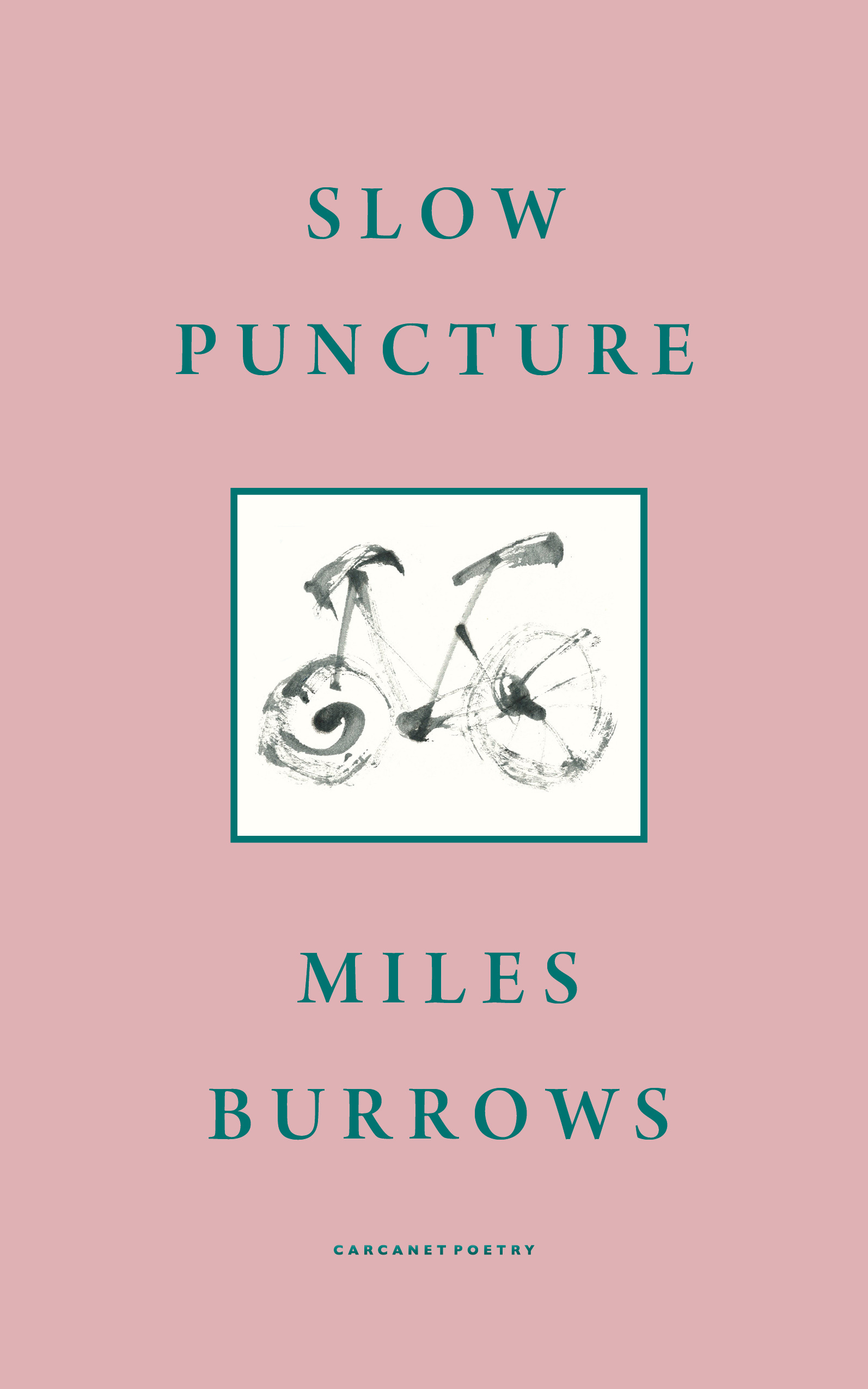
This collection is my fourth book. Slow Puncture is inspired by memories of travel.
I thought of myself as a doctor in a novel: wandering Hampstead Heath at midnight, torn by jealousy, nostalgia and remorse, and running away to work in a leper hospital. The important thing was to be a doctor in a play. Life was after all a play, (didn’t Shakespeare say that?)
My mother was an amateur actress in the Little Theatre in Dover Street. I still have a picture of her in Elizabethan tights, holding a rapier. Eyes sparkling. I was allowed to go backstage between acts and the property manager gave me wooden sword like an Arab sabre, painted silver.
Our family acted and rehearsed plays in our lounge. My schoolmates all had ‘drawing rooms’. A lounge was what pubs had and proved we were North Country and not quite top drawer. Already at six years old I was a detective in our henhouse, a barn in the paddock. Each roosting box was a detective’s office. My younger brother at three years old said “Excuse me” to the larger hens as he queued up with them on the ramp to get in at the hens’ entrance.
For play readings at home, even Dad was roped in, back from the Works. He was reading the part of Ruth. Whenever it came to Ruth’s turn to speak, Dad would pause, clear his throat, and then announce the word “RUTH”, as if distancing himself, and (as if) announcing the arrival of a train, before speaking the lines. My Dad tried to learn German. Die Familie ist in Vaughanzimmer, he would chant over the empty dinner table repeatedly, like some kind of religious chant, but never got further than this, that I can remember.
Every man is his own novel. I could be a young woman dying of tuberculosis in a big hotel in the Swiss Alps, and discussing the meaning of life, in German, looking out at the snow. I sometimes murmur the word ‘Heidegger’ at parties or just by myself when walking along. There is some magic about it. You have to say it quietly with a slightly puzzled expression at parties. “Yes, but… Heidegger?” and then tail off. It can be quite effective if you are stuck in a corner, which you probably will be.
What put it into my mind to be a doctor of all things? It must have been a novel. The Magic Mountain by Thomas Mann. Also a good looking medical student. We had a French book about a doctor who was a hippopotamus, Doctor Popotame. It was called Pourquoi remettre mes culottes?
I liked Mallarme’s poem ‘Le vierge, le vivace et le bel aujourdhui’:
“Will it unveil with a blow of its drunken wing
The transparent glacier of flights unflown?”
At the school singing competition they gave us a song in German ‘Wer reitet so spaet, durch Nacht und Wind?’ about a man galloping through the night with a dying child. I could not understand German. And I don’t think the judge did. After singing this song and winning the singing prize, we were given cornflakes stuck together with melted chocolate, allowed to congeal like little pyramids. We couldn’t understand a word but sang with feeling. (The only German I knew was Achtung, Spitfeuer!)
I joined the poetry society at school. Each of us was T.S. Eliot. We tried to talk and write like we imagined he did.
“The next poem we can’t actually see
In fact, it may not be there at all;
But if it was there, it could solve several problems
In the poems that we can see.
Heavy invisible rapid poem-like entities, which may never be seen or felt,
almost certainly underlie existing poems, and may outweigh them.”
I became a medical student in the days when I collected girls’ names like postage stamps (from unlikely countries). Persephone Perkins was my blue Guadeloupe. Her face like a daisy in a graveyard. The boater hovered like a halo. I followed her au pas de loup. She played real tennis with a triangular racket. The tennis I played began to seem unreal. I discussed Neoplatonism with Professor Krendl. Persephone’s accent was irresistible. But then so was Professor Krendl’s German. Especially when he said Pico della Mirandola.
At the psychiatric hospital fete I was dressed as a gipsy fortune teller, (Madame Zaza). People queued up all the way down to the football pitch towards the front gate, and stayed there till long after the fete was over and even all the police dogs were back in the van. They couldn’t get enough fortune telling. They much preferred it to my clinical manner. They even helped me with my predictions.
The enlightened modern Director had all the walls knocked down, so that patients could easily wander down to the Red Bull down the road, till the publican complained. (Were the patients too noisy? No. They were too quiet). I used to wait on night duty for a visit from the girl called the imaginary princess.
It was all group therapy. Martin was there in the front porch pacing up and down, as if waiting for someone to come and pick him up and take him home. I later found my mother pacing in the hallway of Cherry Tree Lodge, hoping for some visitor at weekends or someone to come and carry her away.
“I’ve just been dumped here! DUMPED,” Mum said in a very loud theatrical voce that would have reached the back stalls as we passed through the lounge on our way to supper in the Cherry Tree Lodge. Mrs. Roberts who used to vacuum the stairs every day was the one person who Mum always remembered. After she died, Mrs. Roberts was the first one who knew exactly the time of cremation and found her way to the right place among all the different little chapels before anyone.
I travel abroad, like a migrant bird. Echoes of travels I like to think are in this book. On the Thai/Laos border the Hmong tribe was stranded between two countries, and we had a camp for them. One child had died and his shirt hung up beside his hut, and empty sleeves were waving in the wind.
In Taiwan, Filipino girls are pushing old people in wheelchairs every morning into the shade under a large tree like the Tree of Life, so many wheelchairs. Every evening the garbage truck comes round each neighbourhood, signalling its approach with a recording of the heart-rending music ‘A Maiden’s Prayer’ by a Polish composer Tekla Bądarzewska-Baranowska. People wait expectantly and gossip in small groups with their rubbish bags at the street corner. A touching old fragmentary song at dusk could be a hopeful description of this collection.
This week's article is by Miles Burrows, author of Slow Puncture, which is published this month! Remember to use code NOVBOOKS10 for 10% off and free UK P&P!
