

Pier 52: Jane Duran
Jane Duran introduces her new collection
This week’s article is by Jane Duran, author of Pier 52, which is published this month.
Get 15% off Pier 52 using code JULYBOOKS15 here.
piers, trees, poems
In an interview with architect Donald Wall, the American architectural sculptor Gordon Matta-Clark said:
‘Everybody, to some extent, accepts architecture as something to look at, to experience as a static object. Few individuals think about or bother visualizing how to work away from it, to make architecture into something other than a static object, into a verb. An action.’1
Matta-Clark was a trained architect, but rather than designing buildings, he sculpted interacting cuts in existing buildings that were derelict, abandoned and/or due for demolition. He opened closed spaces, sculpting by removal. His dramatic architectural sculptures sought to preserve the identity of each property he was making cuts in, while introducing a complex aesthetic by bringing movement, light, space and distance into confined spaces. The language of his artwork was also a critique of contemporary social conditions and polarities: the oppressive conditions of mass housing; the displacement of communities impacted by urban neglect, decay and renewal.
My book Pier 52 explores closed and opened spaces. The title-sequence is a response to Matta-Clark’s artwork: his architectural sculptures, installations and drawing. The second sequence, ‘closed spaces, Palestine’, evokes the enclosures – ever tighter, more restrictive and oppressive – imposed by Israel on Palestine, sustained as they are by surveillance systems, annexations, segregated roads, censorship, bombs…so many interacting forms of closure.
Gordon Matta-Clark (1943-78) was born in New York City, the son of Chilean surrealist artist Roberto Matta Echaurren and American artist Anne Louise Clark. He formed part of a group of artists, dancers, photographers and sculptors in New York City for whom the term anarchitecture became pivotal. He explained the term to Liza Béar in an interview on 21 May, 1974:
‘Architecture is environment too. When you’re living in a city the whole fabric is architectural in some sense. We were thinking more about metaphoric voids, gaps, left-over spaces, places that were not developed.’2
The term anarchitecture articulated and gave rise to fluid modes of enquiry, creativity and collaborative art.
Matta-Clark’s talents and artwork embraced alchemy, drawing, language, photography, dance, film, food, sculpture, architecture… He was fascinated with trees. In his own vibrant notebook-drawings of trees in marker, pencil, ink, crayon, what is most striking is their sheer energy: his trees are abstractions, whirling depictions of flux. His Tree Dance, performed and filmed at Vassar College in 1971, in which the dancers move among the moving branches of a tree but are able to rest in net cocoons, is also an architectural statement.
I think of the perfect architecture of a tree. The sturdy foundation of its roots reach deep and wide enough into the earth to sustain its height and breadth; roots, trunk and balancing branches hold the tree steady; light pours through and among the leaves yet the leaves also shade, shelter and protect; the tree interacts intimately and continuously with sun and water; its branches sway in the wind and its leaves flutter – yet it stays in one place; its aesthetic offers different densities and perspectives as we gaze at and into it. As architectural form each tree is unique, and when the wind disturbs its branches and leaves, its detailed, complex and multi-layered restlessness is unlike that of any other tree anywhere.
Matta-Clark applied his architectural know-how to many artistic collaborative projects. Perhaps his most famous artwork was Splitting (1974): he cut a soon-to-be-demolished suburban New Jersey house in half, beginning with a one-inch vertical cut through all its surfaces. He tilted the rear half back on its slightly lowered cinder block foundations, so the split became a wedge of light. The structure remained stable, while light from the wedge poured down and into the rooms. Matta-Clark also removed all four roof-corners from the attic space. The trees surrounding the house were now exposed in the new spaces. Green entered.
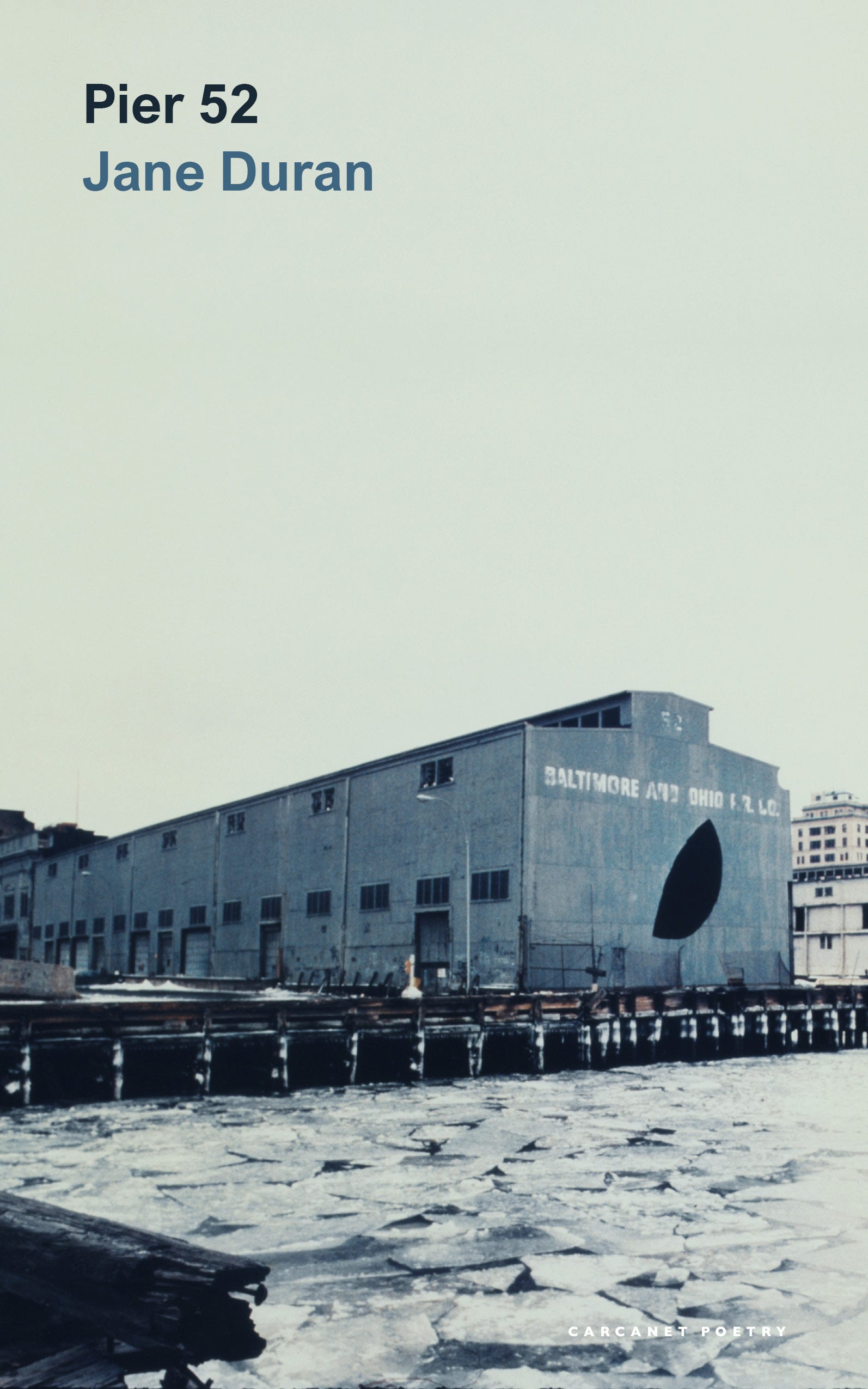
When he made radical cuts into the walls and roof of an abandoned wharf (Pier 52) on the Hudson River, and removed heavy wooden beams from the floor exposing the rushing river below, light and water moved through the pier. Both this artwork (Day’s End, 1975), and Splitting, must have been powerfully disorientating and unsettling to walk through, yet they offered exciting and transporting experiences to those privileged to experience them. As these works no longer exist, we can only visualize them today through archival material: written testimonials as well as photographs and films.
I think of his architectural sculptures and their resonance for poetry: during composition, the power released by cutting, by removal; the illumination offered by introducing space and the unsaid into the poem; the constant, fluent interaction between the poet’s inner and outer worlds; the movement and energy flowing through the shaped thoughts and imagery; the vitality of verbs in the syntax; the disturbance, dislocation and surprising insight that a poem can engender in the mind of a reader: insight, like Matta-Clark’s sculptural cuts, which allow us to see into and also far beyond the confines of the poem.
Is it possible to bring this openness and vitality even into evocations of extreme physical confinement, darkness and repression, so as to expose those situations forcibly? By bringing space and light to them, perhaps they become bearable for a reader to contemplate and think about, to see. In my second sequence on Palestine I have tried to bring movement and breadth into the poems, even though their inexorable reality presses down.
1GMC interview with Donald Wall (n.d. – 1975), Gordon Matta-Clark: An Archival
Sourcebook, University of California Press, 2022, p.136.
2 GMC interview with Liza Béar, 21 May, 1974, GMC, Archival Sourcebook, pp. 95-96.
This week’s article is by Jane Duran, author of Pier 52, which is published this month.